Dry Needling + Exercise Therapy: Why Combining Both Speeds Up Recovery
The pain will decrease even though the issue with the movement will still be there; this is the reason why the pain will come back once the old way of life resumes. Needling treatment and exercise therapy can go together in case of some musculoskeletal conditions. While dry needling treats the trigger points and the muscle tension, the exercise treatment helps improve strength, flexibility, coordination, and self-confidence. In some situations, the effectiveness of both of them can be improved. The MedPhys Rehabilitation clinic provides services of injury prevention and performance.
How Dry Needling and Exercise Therapy Work Together
The benefit of using combination therapy is the consideration of not only acute relief but also functional outcomes in the long run.
- Dry needling in Strathfield therapy might be useful for decreasing muscle tone and sensitivity to pain in some patients.
- Exercise therapy involves the development of muscle strength, endurance, and movement by means of loading.
- A decrease in pain makes exercise therapy more effective.
Combined, these therapies will prove most efficient in the context of individually designed treatment, in which symptom relief enables physical rehabilitation.
Why Active Rehabilitation Matters
Reducing pain is beneficial, but the patient generally needs to get back their capacity to tolerate loading as part of the process.
- Strength training may be used to correct deficiencies that lead to chronic problems.
- Mobility training can help where stiffness is an issue.
- Balance and coordination training can enhance control after the injury.
- Load can help tissues adapt to the stresses being applied.
- Sport-specific training can help to prepare athletes for faster or heavier activities.
Exercise should be progressed in terms of load by a physiotherapist based on symptoms and recovery, and not just on a set program.
When Might This Combination Be Useful?
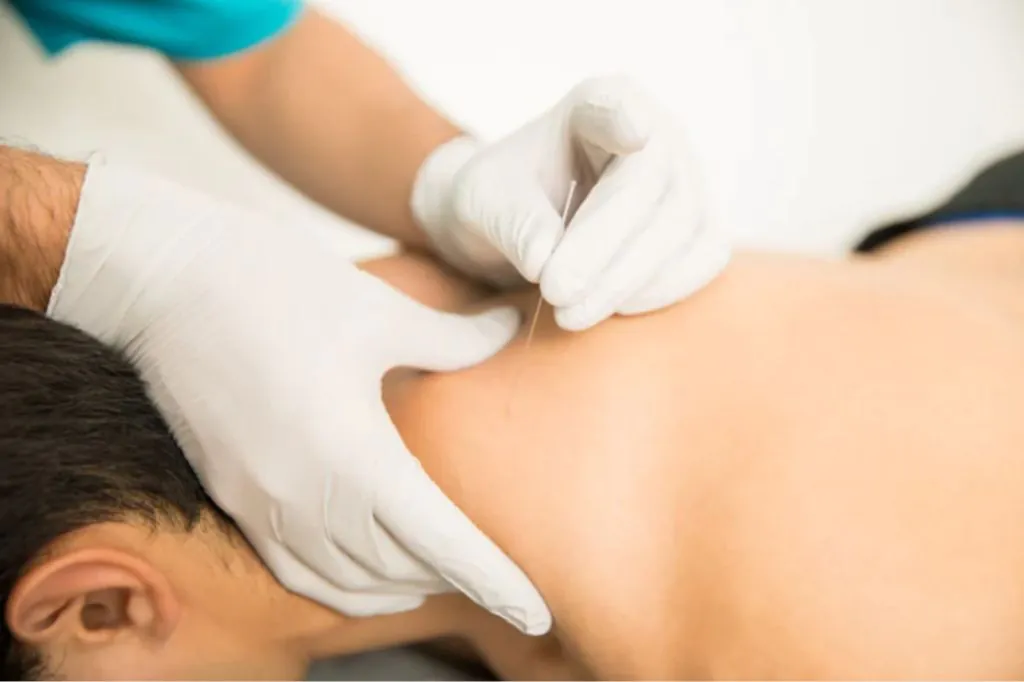
Not everybody needs needling, and it should never be viewed as a cure-all for everyone. Dry needling physiotherapy can be used when there is pain associated with tight muscles or sensitive trigger points and is limiting mobility.
It may be combined with rehabilitation from conditions such as:
- Chronic tightness that limits movement
- Presentation of neck, shoulder or back pain
- Athletic injuries with associated muscle pain
- Pain that limits ability to perform strength training
- Temporary symptom reduction to allow for exercise
For instance, a recreational runner with tight calves who is unable to do strengthening exercises may benefit from dry needling treatment as part of a comprehensive programme, which would also include progressive strengthening of calves, balancing exercises, and sport-specific work-outs. The objective is not just the reduction in tightness but increased function.
Just feeling better does not imply that the athlete is ready to return to full activity.
What to Expect During a Combined Programme
A proper plan for rehab should change according to your improvement in mobility and tolerance.
- Assessment of symptoms, mobility, strength and other contributing factors would be done by your physiotherapist.
- Needling, when appropriate, could just be one part of your physiotherapy session.
- Your exercises should become harder instead of remaining the same during the entire process of recovery.
- Your response to the sessions would help in the modification of loading and activity.
People living locally who want to try dry needling in Concord West should seek out a method of treatment that would consist not only of needling but also of assessment and exercise rehabilitation.
Common Mistakes to Avoid
This is because doing more treatments does not equate to a better treatment option. Quality and suitability of the programme are crucial.
- Dependence on needling: Symptom relief does not substitute for the rehabilitation process.
- Pushing the exercise regimen too soon: Increased work does not mean increased load.
- Neglect of the root cause of the problem: If there are recurring symptoms, then perhaps there is a need to change techniques, load or routines.
- Use of a generic programme: Exercises need to be based on the individual’s health status and physical abilities.
The MedPhys Rehabilitation is all about the process of rehabilitation through carefully planned exercises and performance strategies.
Conclusion
Effective rehabilitation programs extend themselves beyond just providing temporary relief from pain. Physiotherapy is able to provide relief of symptoms through a combination of dry needling when medically advisable and exercise.
If one wishes to pursue a structured program of rehabilitation, MedPhys Rehabilitation can diagnose their medical condition and develop a strategy for meeting their aims, whether it be for returning to work or leisure sports activities, or avoiding re-injury.
FAQs
Q1. Is dry needling painful?
Yes, some people feel the sensation of a needle prick, twitch or pain temporarily. Your reaction may differ based on the body region and technique.
Q2. Am I able to perform physical activities after dry needling?
Usually, you will be able to, but it will depend on the region being treated, your symptoms and your rehabilitation program. Your physiotherapist can provide recommendations.
Q3. Is dry needling for everyone?
Not necessarily. It should be assessed by your healthcare provider, taking into account your health state, symptoms, medication use, injuries and treatment goals.
Q4. How soon can I expect results?
It varies from one person to another. Some people feel changes immediately, whereas others need more sessions and physical therapy exercises.
Q5. Is needling a replacement for physical therapy?
In most cases, it is not. Usually, it is one of the rehabilitation approaches used in combination with other methods.
Get Expert Rehabilitation Guidance
If you experience pain, muscle tightness and injury that affects your movement abilities, please visit MedPhys Rehabilitation and contact us or call us at 0422 785 958. A proper examination will assist in determining if needling or exercise therapy is what you require.
Recent Posts